• A good friend of mine once said, “I don’t ever need any pirates, but I always appreciate seeing them.” This post is for him, I suppose.

    As with all blogs about the miniature wargaming hobby, posting about painting is something that I assume others expect. While that assumption also presumes the existence of an audience for this blog, I may as well continue showing why I want people to play Freebooter’s Fate, and for that, it’s time to talk miniatures.

    The Pirate Demo Crew

    Part of my preparations for demos is building sample crews for each faction. While I have a rough idea of what each model will be, the actual process of acquiring, assembling, priming, painting, and photographing said models is going to be a long, drawn-out challenge. Because this is such a small model-count game, I want to try my best to keep improving at painting – fielding four to eight models that I’ve painted to the best of my ability is going to be more interesting for observers, after all.

    For the Pirate demo crew, I thought the best way to ease back into painting would be with my first Deckhand. See here the humble Pirate:
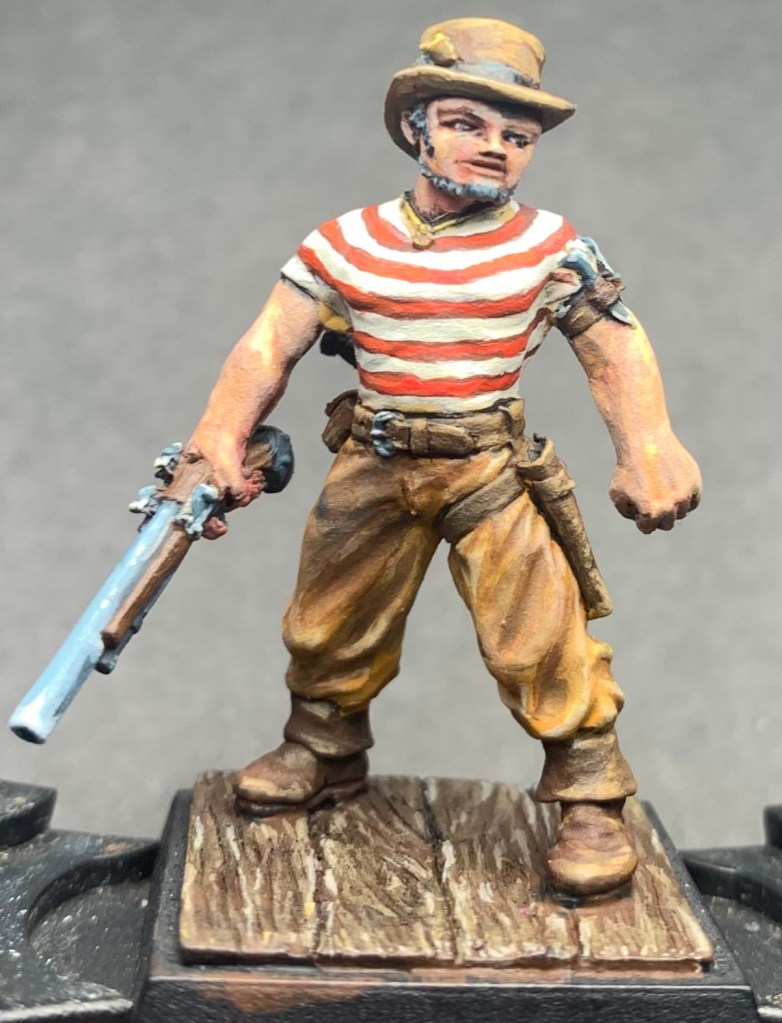
    The humble pirate deckhand.
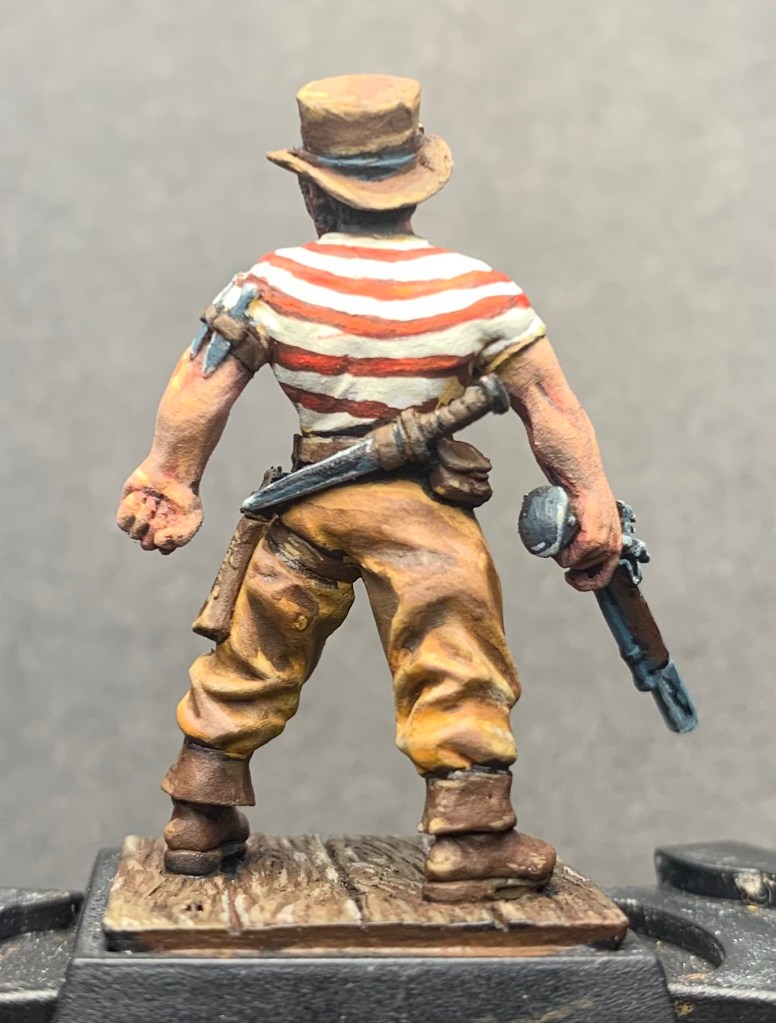
    The rear of the humble pirate deckhand.

    While web formatting, painting, and photography are clearly not my strong suit, I think that this is suitable for my first foray into getting crews painted for demos. This model was coincidentally the first model I attempted to paint back when I initially started getting interested in Freebooter’s Fate in 2013 or so, and I think there are still pictures of the original version out there. Rather than fully stripping, this model got re-primed over the existing paint job because it was a test to see how much fun I had painting him – the painting process predates the creation of this blog and the absolute tear of priming and cutting through my backlog that I’ve been on.

    Color-wise, he’s a pirate. Warm tones were my goal, and much of the lighting and warmth comes from yellows, ochres, and off-white paints. As with most of the pirates (and other models in this game, if I’m being perfectly honest), he’s got a lot of browns and fabric where I’m attempting to try and make the materials look different from one another. Boot brown is not the same as pants brown, which is not the same as the deck or his hat, after all.

    Freehanded stripes were the least difficult part, oddly enough. I painted a full Blood Bowl team of classic-style elves in a purple and white diamond pattern a while back, alongside an 1980s-style Bright Crusaders scheme human/OWA squad, and so that’s helped steady my hands a lot.

    NMM (Non-metallic metals) are the next big thing that I’m trying to work on for all future models. I just don’t like how most metallic paint looks with these miniatures, so it’s a good excuse to get much better at it over time. While the pistol and knives could probably use a lot more work, it was my first attempt after taking a long break from painting minis, so I’m going to just let myself appreciate it for now and repaint it later, once I have a few of my full demo crews done.

    Pirate Demo Crew Thoughts

    Pirates are the first faction most people think of when I tell them it’s a fantasy pirate skirmish game, and the aptly-named pirate deckhand is the perfect encapsulation of that. Every crew needs deckhands, he’s a classic all-rounder piece, and he’s warmed me up for the specialists that I plan to start on soonish. He’ll definitely find a place in whatever demo list I end up choosing to use, which is good for the Pirates, because I still need to figure out which Leader and Specialist I’d like. For a 300 doubloon crew, his 50 doubloon fee is on the higher end of the Pirate deckhands, but his pistol and cutlass definitely help him act as a good all-rounder.

    Hobby Progress

    Today mostly consisted of sorting models, as well as some painting for a few of the other demo crews alongside photography. As I paint more, I’m likely to get a bit faster in terms of preparing models, but for now, I can maybe do 2-3 a week if I’m trying to do my best in terms of painting.
    + , ,
  • Since I spent most of the last post talking about why it’s difficult to get people into Freebooter’s Fate in the US, today, I’m going to explain why I think it’s a great game using an example that isn’t the first thing people will notice. Sure, I could talk about the rules, but this is my blog and so I can talk about ridiculous things here instead of actually posting pictures of stuff I’ve done. It also means I don’t need to figure out how to correct the issue with images displaying with a green filter, because I am trying to be cool with my blog design.

    Basing in Freebooter’s Fate is simple. Miniatures are based on 25mm squares if they are small or medium, a 25mm by 50mm base for some animals (which is pretty uncommon), or a 50mm by 50mm base if they’re a large model. Every model comes with an appropriately sized base, which is pretty standard for the industry. Mechanically, the square bases work well, as line of sight starts along the back edge in a 180 degree arc. Facing is easy to determine, and given that it can be helpful to mark which edge is the back, you can write the model’s name to make it even easier. So far, nothing particularly special.

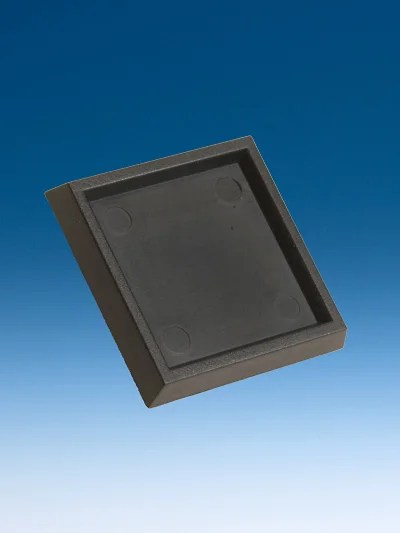
    So what about the actual bases? I said that they’re 25mm squares, but that’s a bit of a simplification. Take a look at the base below:

    A picture of a 25 by 25 millimeter base for Freebooter's Fate.

    Take note of the lip around the base. Rather than generic square bases, these are specifically manufactured for Freebooter Miniatures. The recessed area in the base is 1.5mm deep, 19mm wide at the bottom, and 20mm wide at the top, creating a right-square frustum void in the base. Apart from teaching most people a new geometry term, this void is part of why the bases are so interesting: every miniature comes with a base insert that fits that void.

    The base insert – which is made of the same material as the miniature, meaning it’s normally metal – completely removes the need for pinning more dynamic sculpts to the base, gives it an even weight distribution for better balance, and ensures that every model has an appropriately thematic base. This is perhaps my favorite part of the intentionality of design here: all of these elements combine to combat the typical issues people have with metal models and reduce the work needed to make it seem finished. I know I often stall out around the basing part of a project, so having that taken care of from the start really helps everything seem unified.

    The point of all this musing about bases and design is to get people to think about how the small, seemingly inconsequential elements of a model’s design influence the overall experience. If models with thin limbs and small points of contact needed to be pinned, then the audience would be limited to the kind of people who pin everything. If they were unbalanced due to their combination of weight and pose, then it would be much harder to encourage terrain verticality and make use of the steady footing rule, which says that a model needs to be able to balance on a piece of terrain in order to be placed on it. If thematic basing wasn’t part of assembling the model, then the theme that this game relies on would put an additional burden on players to base everything in an appropriate fashion, which could lead to wildly different-looking crews.

    These bases are emblematic of why I love this game and part of why I’m surprised it’s not more popular.

    Hobby Progress

    The main hobby progress today is working on updating the English translations for the Compañero app: combing through files to ensure that things are translated consistently and reference the latest errata is a time-consuming process that I happen to greatly enjoy. I’ve mostly gone through the headings today, with the bulk of the rules references still waiting for review.

    + ,
  • This blog is an attempt to keep me on track as I steadily work on my plan to build a local community for Freebooter’s Fate, the fantasy pirate skirmish game by Freebooter Miniatures. While convincing people to play a game is always difficult, this game has some additional barriers to entry:

    • Availability: This is a game made in Germany, consisting mostly of hand-sculpted miniatures that are cast in metal. With the current instability around ordering to the United States from abroad and the apparent lack of a US distributor, getting releases is a bit complicated. With individual miniature prices at around €14,50 (currently $16.86 as of posting), this makes it a hard sell to a lot of people, even though you only need between 4-6 miniatures for a full-sized game. There’s also enough items that you need to play that are specific to the game and aren’t easily replicable – the Game cards (including hit location, fate cards, Loas, and equipment), Boat deck, Equipment & Loas deck, and Shadows deck are all needed to have all of the game’s mechanics available.
    • Theme: Pirates are cool, and fantasy pirates are cooler. Unfortunately, it is an incredibly narrow niche for a game, so trying to convince others to play requires them to buy-in to the conceit. There’s also some themes in the background of the game that I’ll end up writing about because I am incapable of not critically analyzing anything I enjoy.
    • Resources: English-language resources for Freebooter’s Fate are few and far between. The Compañero 2.0 is an excellent crew building resource, but the English version is still being updated and corrected. The books are available on Wargame Vault as PDFs, but print versions of the latest Tales of Longfall books don’t exist in English quite yet and – as someone who likes having books for table reference – is a bit of a bother. There’s even an untranslated book for Campaigns, which I haven’t quite managed to take a look at yet.
      • For anyone who doesn’t speak German: select Einstellungen (the sixth link on the landing page) and change Deine Sprache to English. I’m also helping to correct the English rules information, so updates to that will inevitably be posted here as part of the project.
    • Terrain: A good amount of terrain with verticality that fits the theme can be hard to come by. Amazons in particular require jungle terrain to really feel like they’re competitive or fun to play.
    • Out of Production Items: While this is something that happens to every game, there’s a few items that are out of production that I would like more of. The standout introductory scenario, Attack of the Zombie Octopuses, does not actually have any miniatures currently available. There’s also some tokens that I would love to have more of, including ammo counters and Numskull tokens.
    • Metric: As I am in the US, many of my gaming peers are somewhat skeptical of using centimeters. This is a small issue, but it’s a barrier that needs to be acknowledged when trying to get others to play.

    There are a ton of barriers in my way, so I plan to tackle them bit-by-bit. I’ve already primed and started painting my initial demo crews, I have access to a bunch of high-quality terrain at my local gaming shop (who will get a shoutout as soon as I feel okay to let people know I have a blog), and I am dedicated to getting through my backlog enough to attract interest to this game.

    Hobby Progress

    I started a blog. I also told people why this game is a hard sell, which is probably not a great way to get people interested, but I’m a natural pessimist so I may as well be honest.

    + ,