Since I spent most of the last post talking about why it’s difficult to get people into Freebooter’s Fate in the US, today, I’m going to explain why I think it’s a great game using an example that isn’t the first thing people will notice. Sure, I could talk about the rules, but this is my blog and so I can talk about ridiculous things here instead of actually posting pictures of stuff I’ve done. It also means I don’t need to figure out how to correct the issue with images displaying with a green filter, because I am trying to be cool with my blog design.
Basing in Freebooter’s Fate is simple. Miniatures are based on 25mm squares if they are small or medium, a 25mm by 50mm base for some animals (which is pretty uncommon), or a 50mm by 50mm base if they’re a large model. Every model comes with an appropriately sized base, which is pretty standard for the industry. Mechanically, the square bases work well, as line of sight starts along the back edge in a 180 degree arc. Facing is easy to determine, and given that it can be helpful to mark which edge is the back, you can write the model’s name to make it even easier. So far, nothing particularly special.
So what about the actual bases? I said that they’re 25mm squares, but that’s a bit of a simplification. Take a look at the base below:
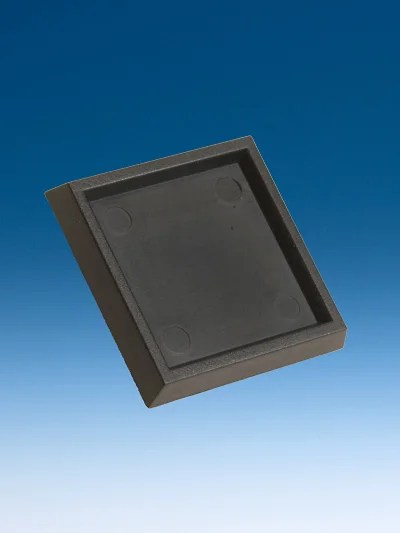
Take note of the lip around the base. Rather than generic square bases, these are specifically manufactured for Freebooter Miniatures. The recessed area in the base is 1.5mm deep, 19mm wide at the bottom, and 20mm wide at the top, creating a right-square frustum void in the base. Apart from teaching most people a new geometry term, this void is part of why the bases are so interesting: every miniature comes with a base insert that fits that void.
The base insert – which is made of the same material as the miniature, meaning it’s normally metal – completely removes the need for pinning more dynamic sculpts to the base, gives it an even weight distribution for better balance, and ensures that every model has an appropriately thematic base. This is perhaps my favorite part of the intentionality of design here: all of these elements combine to combat the typical issues people have with metal models and reduce the work needed to make it seem finished. I know I often stall out around the basing part of a project, so having that taken care of from the start really helps everything seem unified.
The point of all this musing about bases and design is to get people to think about how the small, seemingly inconsequential elements of a model’s design influence the overall experience. If models with thin limbs and small points of contact needed to be pinned, then the audience would be limited to the kind of people who pin everything. If they were unbalanced due to their combination of weight and pose, then it would be much harder to encourage terrain verticality and make use of the steady footing rule, which says that a model needs to be able to balance on a piece of terrain in order to be placed on it. If thematic basing wasn’t part of assembling the model, then the theme that this game relies on would put an additional burden on players to base everything in an appropriate fashion, which could lead to wildly different-looking crews.
These bases are emblematic of why I love this game and part of why I’m surprised it’s not more popular.
Hobby Progress
The main hobby progress today is working on updating the English translations for the Compañero app: combing through files to ensure that things are translated consistently and reference the latest errata is a time-consuming process that I happen to greatly enjoy. I’ve mostly gone through the headings today, with the bulk of the rules references still waiting for review.
 Brew City Freebooter
Leave a comment